
Criminal Court Records in Kemper County
A Kemper County criminal court record is the official case file a court clerk opens once the State of Mississippi files a charge against a named defendant. The file grows as the case moves forward. It collects the indictment or charging paper, arraignment entries, bond orders, motions, plea petitions, hearing notes, the verdict or plea, and the final sentencing order. The Circuit Clerk keeps Circuit Court criminal litigation papers, including indictments, motions, process, jury records, and judgments. This case-level record is broader than a booking entry or a single charge sheet, because it captures the full life of the prosecution.
Two state courts produce most criminal records in Kemper County. The Circuit Court is the felony forum for the 10th Circuit District, where Judges Robert T. "Bo" Bailey and Charles W. Wright Jr. preside over serious prosecutions. Justice Court handles preliminary felony matters, many misdemeanors, and criminal violations that happen outside city limits. A felony case often starts with an initial appearance in Justice Court and then moves to Circuit Court after a grand jury returns an indictment. The booking charges listed on the sheriff jail roster can change once a case reaches court, so the case file is the better source for charge status. The jail side of a case is covered on the Kemper County inmate records page.
How to Search Kemper County Criminal Court Records
Most Kemper County criminal cases are tracked through Mississippi Electronic Courts, the statewide system known as MEC. The 10th Circuit District went live on MEC on April 14, 2025, and full document access sits behind a registered login. When the portal is not open to a public user, the Circuit Clerk counter is the next stop for reviewing or copying a file.
- Open the Mississippi Electronic Courts system through the state judiciary site and select the 10th Circuit District that includes Kemper County.
- Search by defendant name, or by the exact MEC case number when you already have it.
- Narrow the results by court, case type, and filing date to find the right criminal file.
- Open the case to read the docket entries, charges, plea, and disposition.
- Ask the Circuit Clerk for a certified copy of any order or judgment you need for legal use.
Mississippi does not run a free statewide criminal-history lookup for everyday users, so a single online name search will not always return a full record. For people sentenced to state prison, the Mississippi Department of Corrections inmate search is a separate channel, and the county sheriff publishes a current jail roster for people held locally. Note: MEC document access is gated by login, so the Circuit Clerk remains the practical route for a certified Kemper County criminal court record.
Stages of a Kemper County Criminal Case
A criminal case in Kemper County moves through clear stages, and each step leaves its own mark in the court file. The charges are filed first, then the defendant is arraigned, then the case works through pretrial motions before it ends in a plea or a trial. Reading these stages in order helps make sense of what a Kemper County docket is showing on any given date.
Case flow: Charges Filed › Arraignment › Pretrial / Motions › Plea or Trial › Disposition › Sentencing
| Stage | What Happens |
|---|---|
| Charges Filed | A charge reaches the court by complaint, information, or a grand jury indictment, which opens the case file. |
| Arraignment | The defendant is formally told the charges and enters a plea of guilty or not guilty. |
| Pretrial / Motions | Lawyers file motions, exchange evidence, set bond terms, and ask for hearings or continuances. |
| Plea or Trial | The case ends in a negotiated plea or goes to trial before a judge or jury. |
| Disposition | The outcome is entered, such as guilty, not guilty, dismissed, or transferred. |
| Sentencing | After a conviction the court orders the penalty, such as prison, probation, fines, or restitution. |
What a Kemper County Criminal Court Record Shows
A full Kemper County criminal court record holds far more than a name and a charge. It ties together the people, the accusation, the court events, and the money owed at the end of a case. The fields below appear across most Circuit Court criminal files, though some entries may be redacted to protect identifiers like Social Security numbers and minors' names.
| Field | What It Shows |
|---|---|
| Case Number | The MEC case number assigned by the court, used exactly as the clerk records it. |
| Defendant | The person charged, listed as the defendant against the State of Mississippi. |
| Charges | The criminal charge labels and the statute or cause behind each count. |
| Attorneys | Counsel of record, appointed or public counsel where shown, and the prosecutor. |
| Plea | The defendant's formal response, such as guilty, not guilty, or no contest. |
| Docket Entries | Motions, hearings set, continuances, orders entered, and other dated events. |
| Disposition | The result of each charge, such as convicted, acquitted, dismissed, or transferred. |
| Sentence | The penalty ordered, including prison or jail time, probation, fines, and restitution. |
Reading Dispositions and Sentences
The disposition is the part of a Kemper County criminal court record that tells you how a charge ended. One Kemper County case can carry several charges, and each charge gets its own disposition. A sentence only appears after a conviction, so a dismissed or acquitted charge will show no penalty at all. Reading both fields together gives the true outcome of a case rather than just the accusation that started it.
- Guilty / convicted: the defendant pleaded guilty or was found guilty, and a sentence follows.
- Not guilty / acquitted: the court or jury did not find guilt, and no sentence is entered.
- Dismissed: the charge was dropped by the court or the prosecutor and does not lead to a sentence.
- Nolo / no contest: the defendant did not contest the charge, which the court can treat as a conviction.
- Pending / open: the case is still active and has no final outcome yet.
A sentence in the file may combine more than one penalty. A felony conviction in Kemper County Circuit Court can carry a prison term with the Mississippi Department of Corrections, a period of probation, fines, court costs, and restitution paid to a victim. Note: a sentence can be suspended or split, so the order itself controls the real terms, not a short docket summary.
Charges vs. Convictions in Kemper County
Being charged is not the same as being convicted, and a Kemper County criminal court record can show charges that were later dropped, dismissed, or ended in acquittal. A charge is only an accusation that the state must still prove. A conviction is the finding of guilt that follows a plea or a verdict. The closer look at the charges themselves, including how they get amended or reduced, lives on the Kemper County arrest records and court charges page.
| Charge | Conviction | |
|---|---|---|
| Stage | Accusation filed | Verdict or plea entered |
| Burden of Proof | Probable cause | Beyond a reasonable doubt |
| Can Change | Amended, reduced, or dropped | Final unless appealed |
| Leads to Sentence | No | Yes |
| Public Record | Yes | Yes |
Who Prosecutes and Defends Kemper County Criminal Cases
Felony criminal cases in Kemper County are prosecuted by the 10th Circuit Court District Attorney, an office led by Kassie Coleman and based in Meridian. The district covers Lauderdale, Clarke, Kemper, and Wayne counties. The District Attorney handles grand jury proceedings, felony charges such as drug crimes, burglary, and aggravated assault, plus revocations and pretrial intervention. The office does not prosecute misdemeanor tickets or civil matters, which stay in Justice Court or a municipal court.
The role of the felony prosecutor is described on the 10th Circuit District Attorney site, which explains the four-county district and its caseload.

Because the District Attorney prosecutes only felonies, the court that handled a charge tells you who pressed it forward. A felony bound over from Justice Court reaches the District Attorney and the grand jury, while a minor charge may never leave the lower court.
Kemper County defendants who cannot afford a lawyer may receive appointed counsel. Mississippi runs the Office of State Public Defender, which supports appeals, capital defense, youth defense, and training, although local trial defense in Kemper County is often arranged through the court that hears the case.

No Kemper-specific public defender office was located in the official sources, so a defendant should ask the Circuit Court directly about appointed-counsel procedures. The state agency also keeps a public defender directory for finding listed defenders.
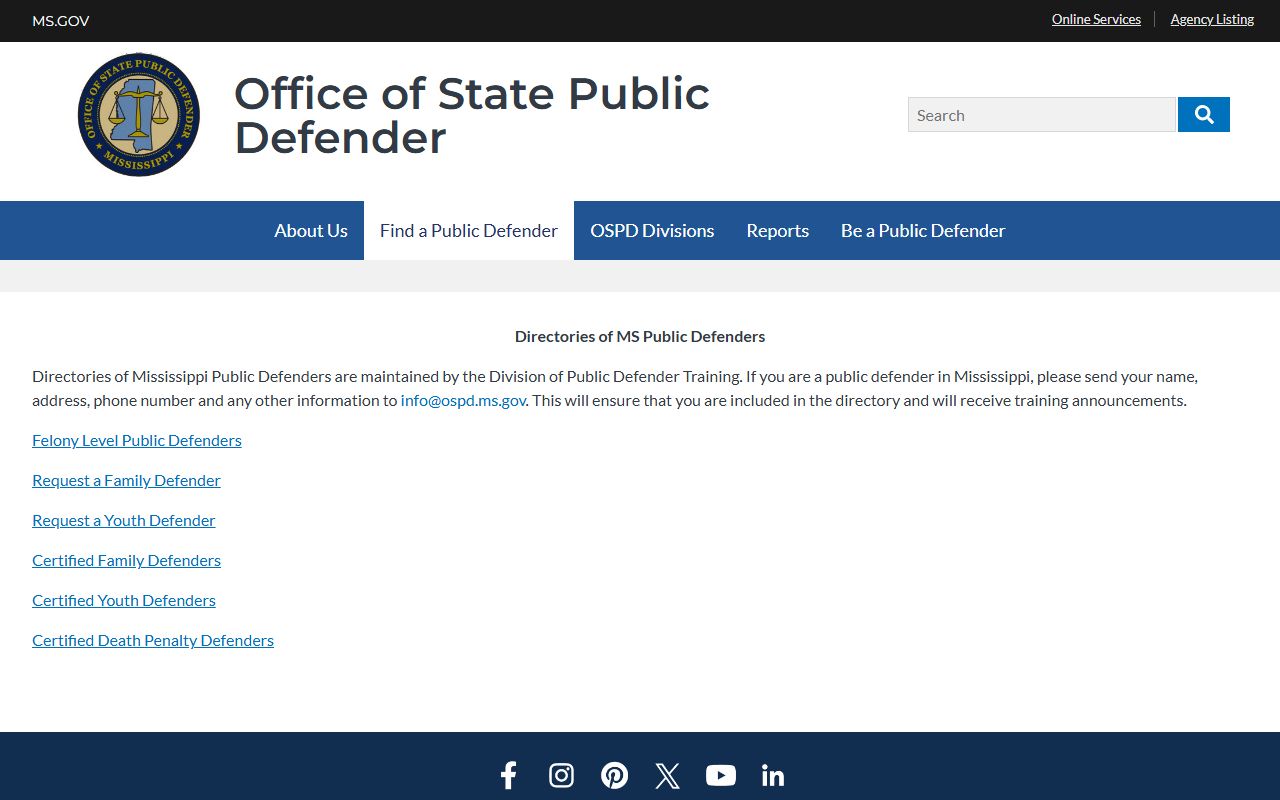
The directory page explains how Mississippi public defenders are added to the state listing, which is useful when no local defender contact is published for the county.
Sealed vs. Expunged Records
Some Kemper County criminal records are removed from public view through sealing or expunction, and the two are not the same. A sealed record still exists but is hidden from ordinary searches. An expunged record is treated as though the matter never happened for most public purposes. Mississippi expunction is governed mainly by Miss. Code Section 99-19-71, which a person files in the court of conviction.
| Sealed | Expunged | |
|---|---|---|
| Visibility | Hidden from public search | Removed and treated as if it never existed |
| Law Enforcement | Limited access remains | Very limited uses remain under law |
| Eligibility | By court order in the case | Certain misdemeanors, some felonies, dismissed or not-guilty outcomes |
Eligibility for expunction depends on the exact offense, prior record, waiting period, and statutory exclusions. A request should identify the arresting agency, the charge, the court, the case number, the disposition date, and the sentence-completion date. If a case began in Justice Court but was indicted in Circuit Court, the requester should confirm which court holds the final record. Fees and local form names were not located in official Kemper County sources, so the clerk of the court of conviction is the place to confirm them. Note: a charge name alone does not prove eligibility, so route eligibility questions to the court or an attorney rather than assuming.
Public Access to Kemper County Criminal Court Records
Mississippi policy favors public inspection of court records unless a statute or court order closes them. For Kemper County criminal court records, the first practical step is to ask the office that actually keeps the file, which for felonies is the Circuit Clerk. A good request names the defendant, the case number, the court, and the dates, and asks for a plain or certified copy. The Public Records Act supports access, but it does not override sealing orders, expunction orders, juvenile confidentiality, or the login rules of the electronic court system.
Key Statutes:
Miss. Code § 25-61-1 - sets Mississippi's policy that public records are open for inspection unless an exemption applies.
Miss. Code § 9-7-81 - gives the Circuit Court general jurisdiction over felony prosecutions and other law matters.
Not every criminal-related document is open. The Mississippi Department of Public Safety explains that search warrants and investigative reports can be withheld as investigative materials, and that driving records and crash reports are not public records.
These limits are spelled out in the DPS public-records FAQ, which lists the categories the agency does not release on request.
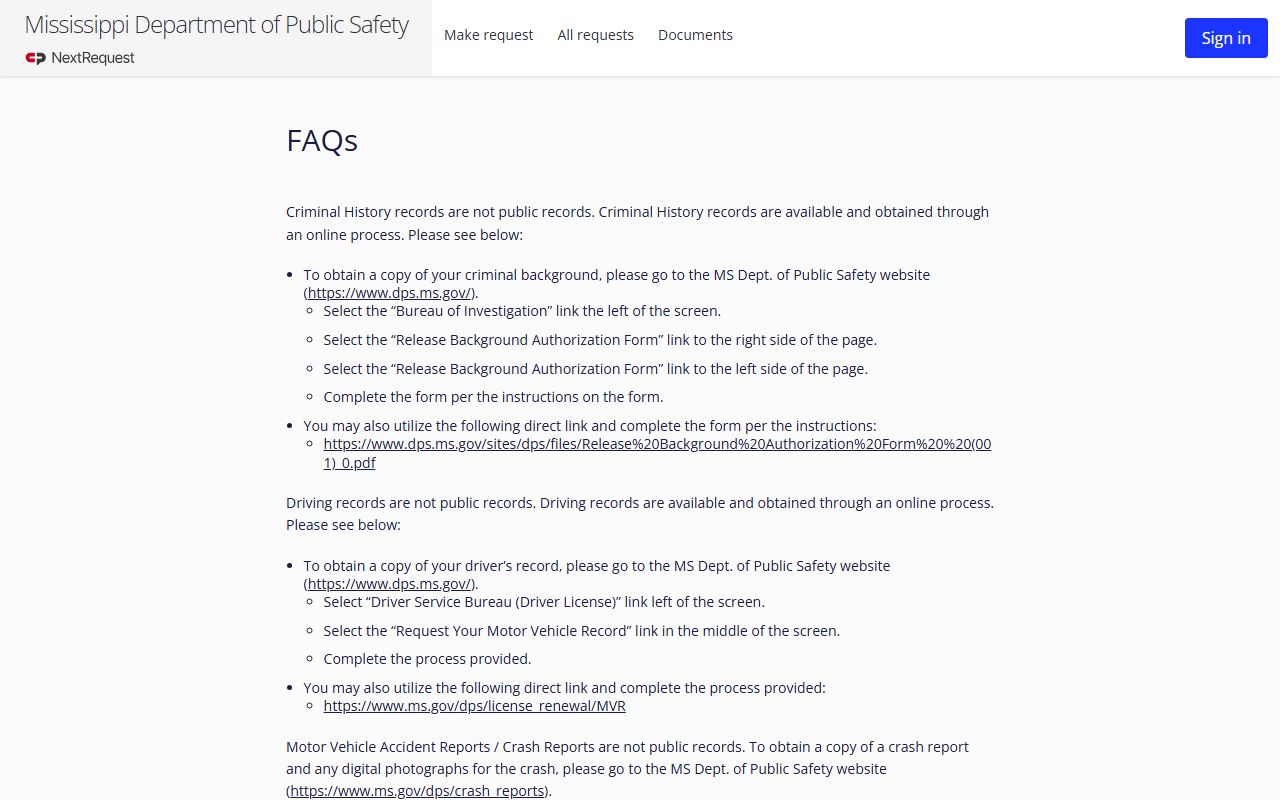
The FAQ is a useful reminder that an open court file and a closed investigative file are different things, even when they concern the same arrest.
Background Check Considerations
A casual name search of Kemper County criminal court records is not the same as a regulated background check. Kemper County court records can be incomplete, out of date, or pending further court action, and booking charges can change once a case is heard. Anyone making a hiring, housing, or credit decision must use a screening process that follows federal law rather than a quick public lookup.
Important: This site is not a consumer reporting agency under the Fair Credit Reporting Act, and its information cannot be used for employment, tenant, credit, or insurance screening.
Restricted Kemper County Criminal Court Records
Several kinds of Kemper County criminal court records are restricted or fully confidential. The court withholds them to protect children, victims, privacy, and active investigations. A docket may show a limited entry or none at all for these matters, and a clerk search will not return the closed file.
- Juvenile records: youth proceedings are not ordinary public adult records and are limited to authorized people.
- Sealed cases: records sealed by court order are not disclosed through normal clerk searches.
- Expunged cases: an expunction order removes eligible arrest, charge, and conviction records from public access.
- Investigative reports and search warrants: the DPS FAQ treats these as investigative materials that may be exempt.
- Personal identifiers: Social Security numbers, minors' names, medical details, and protected addresses are redacted.
When a record is restricted, the path forward is to contact the court that handled the case and confirm what, if anything, can be released. Active investigative files stay closed even when the underlying arrest is widely known, so the open court docket may be the only public part of the matter.