
Probate in Kemper County Chancery Court
Kemper County does not run a separate probate court with its own judge. Probate is heard by the Chancery Court, which is Mississippi's court of equity, and the case files are kept by the Chancery Clerk. The Chancery Clerk, Sherline D. Watkins, serves as clerk of the Chancery Court and stores estate files, guardianship matters, and the rest of the equity docket. The label "Probate Records" stays useful for searchers, but the real venue in Kemper County is the Kemper County Chancery Court, not a separate probate division.
Two chancellors preside over the court. D. Joseph Kilgore holds Post 1 and Kiley Kirk holds Post 2, and the county groups its chancery work with Neshoba and Winston counties. The Mississippi Judiciary explains the court's reach on its Chancery Courts page, which lists divorce, adoption, probate, guardianship, sanity hearings, and land matters as core equity business. That statewide overview lines up with what the county Chancery Court office handles day to day.
Mississippi has long split its law courts from its equity courts. Estates of decedents and all issues involving minors fall to Chancery under Miss. Code Section 9-5-81. That is why a will, an estate, or a guardianship is filed with the Chancery Clerk rather than the Circuit Clerk who keeps the felony and civil-litigation files.
What Kemper County Probate Records Cover
Probate is the court-supervised process of settling what a person leaves behind. A Kemper County probate record can open with or without a last will and testament, and it follows the estate from the first petition to the final closing order. The same court branch also opens guardianships and conservatorships, which protect people rather than estates. These files often hold sensitive material about heirs, money, and health, so parts of them may be limited.
The Chancery Clerk page confirms that the office handles estates, guardianships, conservatorships, and other equity matters as clerk of the court. The most common Kemper County probate records that the Kemper County Chancery Clerk keeps include the following.
- Estate case files opened with a will, known as testate matters, and files opened without a will, known as intestate matters.
- Wills admitted to probate and the petitions asking the court to open an estate.
- Letters testamentary and letters of administration that authorize someone to act for the estate.
- Heirship and beneficiary filings that establish who inherits.
- Creditor notices, claims, inventories, and accountings filed during administration.
- Orders approving the sale or distribution of estate property.
- Guardianship and conservatorship filings for minors or incapacitated adults, plus minor settlement matters.
Will contests are part of this docket too. The county Chancery Court page treats a will contest as one of the few categories where a jury may be seated, a point covered further below.
Probate Terms Defined
Probate paperwork leans on a handful of legal words that decide who controls an estate and who answers to the court. Reading a Kemper County estate file is much easier once these terms are clear. The short glossary below defines the ones that appear most often in petitions, orders, and letters.
- Testator
- The person who made the will. A valid will speaks for the testator's wishes after death.
- Executor
- The person the will names to carry out its terms, collect assets, pay debts, and distribute what remains.
- Intestate
- Dying without a valid will. State law of descent then decides who inherits the estate.
- Administrator
- The person the court appoints to settle an estate when there is no will or no named executor able to serve.
- Guardianship
- A court arrangement that gives one person legal authority over a minor or a person who cannot manage their own affairs.
- Conservatorship
- A court arrangement focused on managing the property and finances of a person found unable to do so alone.
How Probate Works in Kemper County
Opening an estate follows a set order in Kemper County, and each step lands a document in the Kemper County Chancery Clerk's file. Knowing the sequence helps a family member, an heir, or a researcher figure out which paper should exist and what to ask for. The walkthrough below mirrors the chancery process the county and state describe.
- Decide what kind of matter it is. Confirm whether the case is a decedent's estate, a guardianship, a conservatorship, a minor's estate, or a related equity issue.
- File with the Chancery Clerk, not the Circuit Clerk. Probate, estate, and guardianship papers belong to the chancery side of the courthouse.
- Provide the core facts. Give the decedent or ward name, the date of death or triggering event, property details, the will status, the heirs, and an existing case number if one exists.
- Let the chancellor handle the matter. The chancellor generally hears chancery cases without a jury, though a jury is allowed in a will contest.
- Build the file. A probate file may grow to include petitions, notices, orders, inventories, accountings, and final closing papers.
- Request certified copies when needed. Certified copies of orders or letters must come from the Chancery Clerk.
- Expect limits on sensitive files. Guardianship, adoption, minor, and mental-health records may be restricted even when an estate docket is otherwise open.
Note: Estate, guardianship, and conservatorship cases are chancery matters, so direct every probate question to the Chancery Clerk rather than the Circuit Clerk who keeps criminal and civil files.
How to Search Kemper County Probate Records
There is no free public portal that returns every Kemper County estate file with one search. Access runs through a mix of the statewide electronic court system, the Chancery Clerk's counter, and written requests. Mandatory attorney e-filing began for the Chancery Court of Kemper County on November 27, 2017, so newer chancery cases are managed electronically even when the public view is limited.
Mississippi Electronic Courts, known as MEC, is the state's e-filing and case-access system, reachable through the judiciary's MEC page. MEC may include participating chancery cases, but open free probate search fields were not available during review, and document viewing can require a login or subscription. Sensitive guardianship and minor records may be withheld entirely. When the online channel stops short, the file still exists at the courthouse.
The reliable channels for Kemper County probate records work like this. Use the route that matches the record you need.
- In person at the Chancery Clerk's office in the courthouse at 123 Main Ave., De Kalb.
- By phone to the Chancery Clerk's updated direct line, 601-743-8368.
- By mail to the Chancery Clerk at P.O. Box 188, De Kalb, MS 39328.
- Through a public-records request that names the decedent or ward, an approximate year, the case number if known, and the document type.
Older estate files take extra patience. The Chancery Clerk stores and disposes of many county records after their active use, so an older probate file may sit in office storage, an archive, microfilm, or an index. For anything that predates electronic filing, ask the clerk whether the file is on hand, archived, microfilmed, or simply unavailable before assuming it is lost.
Kemper County Chancery Court Contacts
Probate runs through two sets of officials in Kemper County, and both sit in the courthouse in De Kalb. The Chancery Clerk keeps and copies the files, while the chancellors decide the cases. For most record requests the Chancery Clerk is the first call. The cards below carry the office details drawn from the county's official pages.
Chancery Clerk (Sherline D. Watkins)
P.O. Box 188
De Kalb, MS 39328
601-743-8368
Mon-Fri 8 a.m. to 5 p.m.
Chancery Court Chancellors
D. Joseph Kilgore, Post 1
Kiley Kirk, Post 2
601-743-8375
Fax 601-662-0314
The Chancery Clerk also keeps divorce, custody, and adoption files, which is why the same office handles the Kemper County marriage and divorce records on the chancery side. A fuller profile of the office, its duties, and its request methods sits on the Chancery Clerk page.
Probate Filing Fees in Kemper County
Costs in a probate case fall into two groups: the fees to open and run an estate, and the charges for copies of what is filed. A certified copy carries the clerk's seal and is the version courts and agencies accept, while a plain copy works for personal reference. Kemper County did not publish a local probate fee schedule in the official sources reviewed, so the amounts below are not set here.
| Fee or Filing | Amount |
|---|---|
| Open an estate | Confirm with the Chancery Clerk |
| Certified probate copy | Confirm with the Chancery Clerk |
| Plain copy | Confirm with the Chancery Clerk |
| Guardianship or conservatorship filing | Confirm with the Chancery Clerk |
Important: No official Kemper County probate fee list was found, so confirm the exact cost to open an estate or to obtain a certified copy directly with the Chancery Clerk before paying.
Will Contests and the Jury Note
Most chancery business is decided by the chancellor alone. A will contest is the exception that families notice most. When an interested party challenges whether a will is valid, the question can reach a jury, which is unusual for an equity court. The county Chancery Court page names will contests as one of the limited categories where juries are permitted, alongside paternity cases.
Outside of those narrow categories, the chancellor hears probate matters without a jury and may use an advisory jury only on rare occasions. That structure shapes the record. A contested estate file may include jury-related papers, while a routine administration moves through orders signed by the chancellor.
Note: A jury can decide a Kemper County will contest, but the chancellor hears ordinary probate and guardianship matters without one, which keeps most estate files free of jury records.
Restricted Kemper County Probate Records
An open estate docket does not mean every page inside the file is public. Probate touches families at their most private, and Mississippi law shields parts of these Kemper County records. The Chancery Court's own jurisdiction includes commitments of people impaired by mental disability or substance abuse, and those proceedings carry medical detail that is restricted or redacted.
Several categories commonly limit what a requester can see. Guardianship and conservatorship files for minors and incapacitated adults often hold protected health, financial, and identifying information. Adoption files, which are also a chancery matter, are highly confidential and generally require statutory authority or a court order to view. Records sealed by court order may show only a thin docket entry or nothing at all. Personal identifiers such as Social Security numbers, account numbers, minors' names, and medical data may be redacted before any release.
When part of a file is closed, the clerk can still point to what is available. Ask whether a public docket sheet, a final order, or a redacted copy exists, even when the full file is not open at the counter.
Federal Estate Matters Are Separate
Probate itself stays in state Chancery Court, but families sometimes confuse it with federal matters that touch an estate, such as a bankruptcy filed before or after a death. Those cases are not probate and never run through the Chancery Clerk. Kemper County sits in the U.S. District Court for the Southern District of Mississippi, and that court keeps the federal civil and criminal files that affect county residents.
The federal district court explains its offices and case access on the Southern District of Mississippi homepage. It confirms that the court handles federal cases rather than the estate, guardianship, and conservatorship work that belongs to Chancery Court.
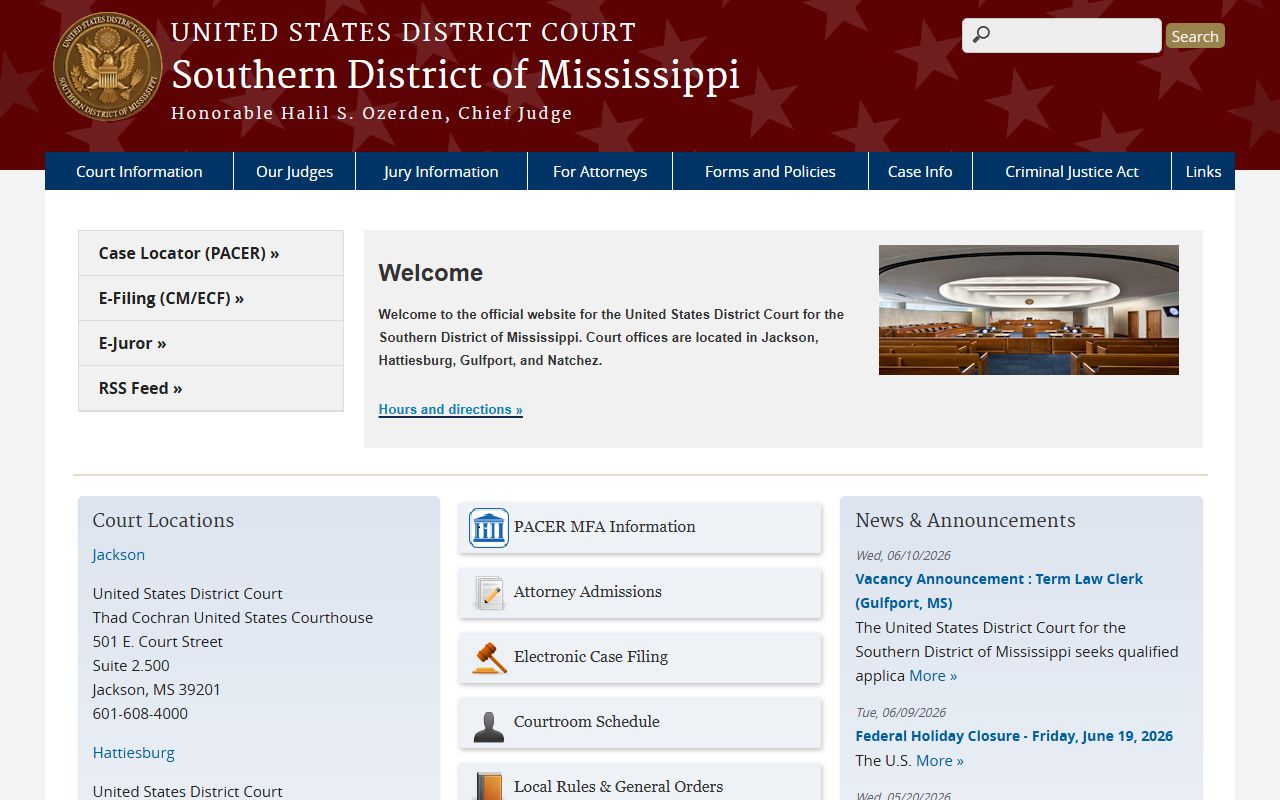
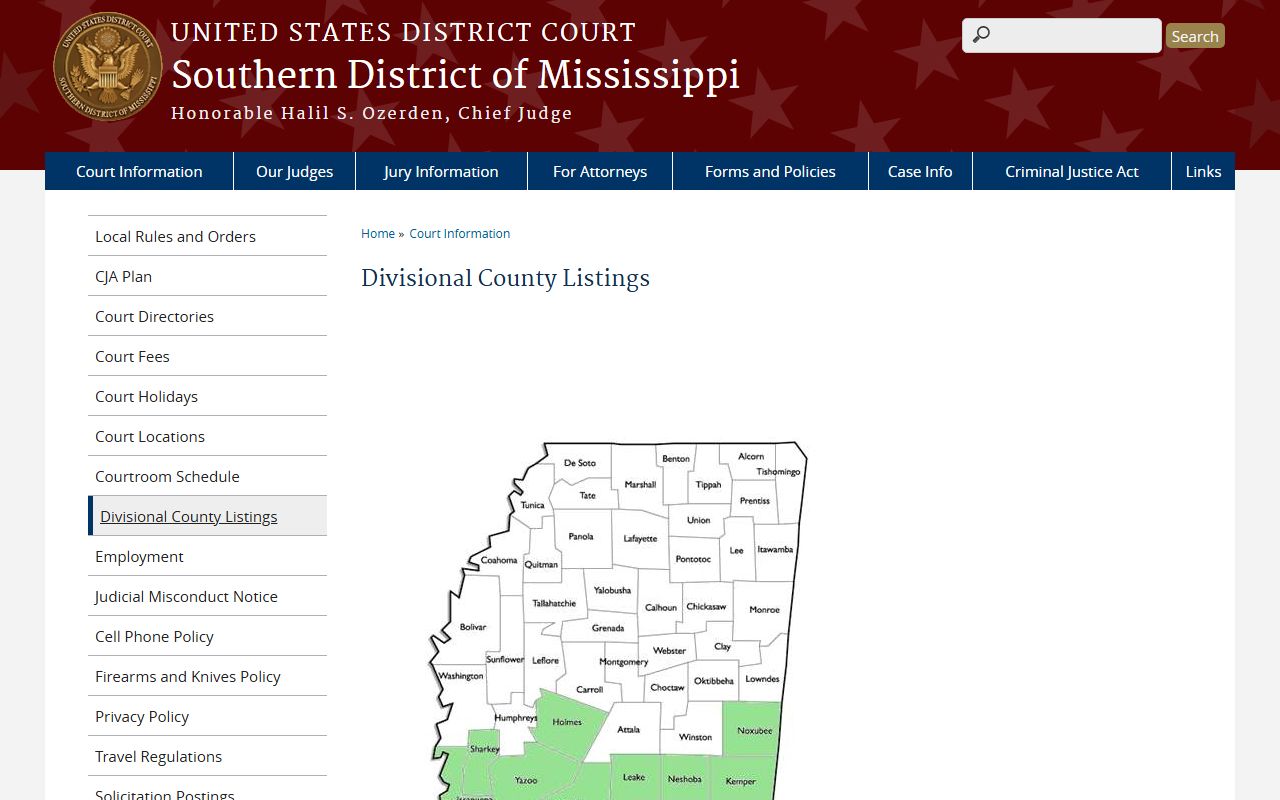
Because the district covers many counties, the court publishes a divisional list that places each one in the correct division. Kemper County appears in the Northern Division on the divisional county listings, with that division's court held in Jackson. That listing tells a searcher where a federal matter from Kemper County would be filed.
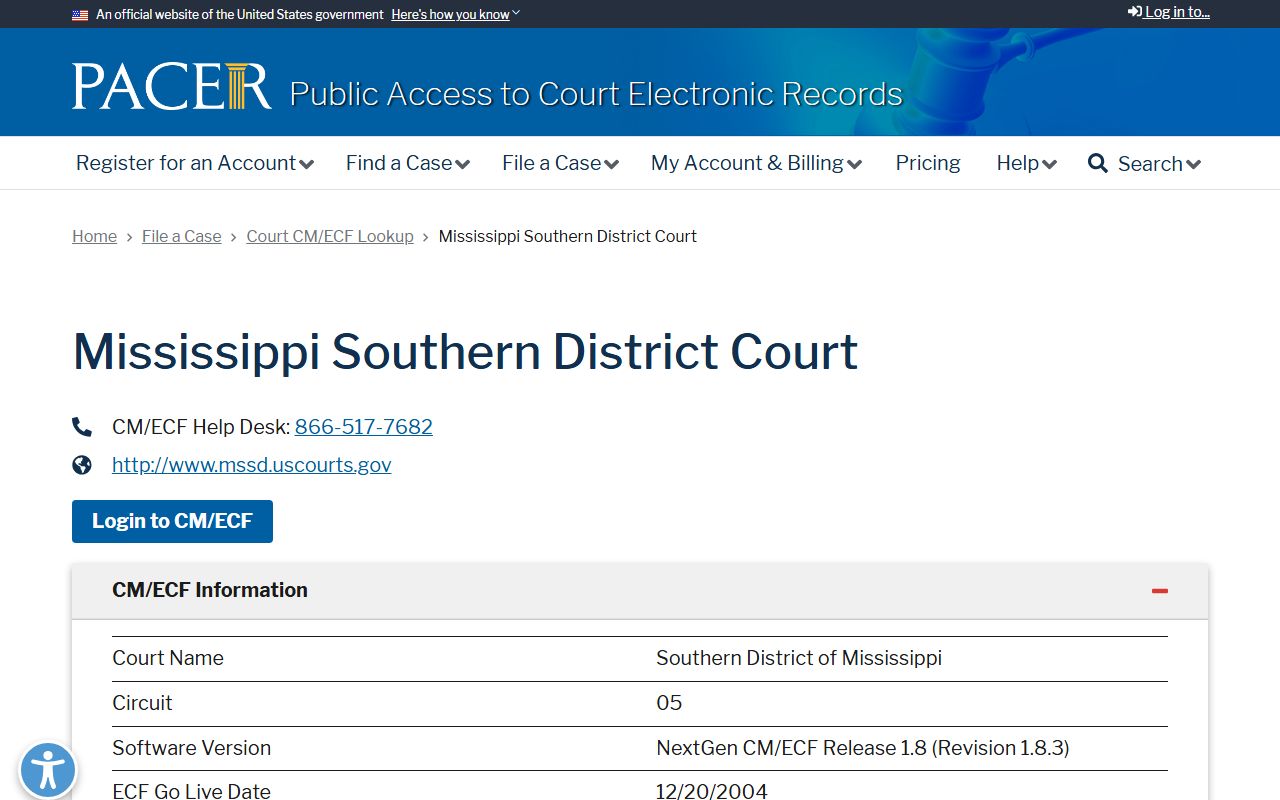
Federal dockets are searched through PACER rather than MEC or the Chancery Clerk. The court's entry in the PACER lookup for the Southern District of Mississippi points to the electronic system that holds those federal case records. PACER requires registration and charges fees, so it is a separate path from any county probate search.
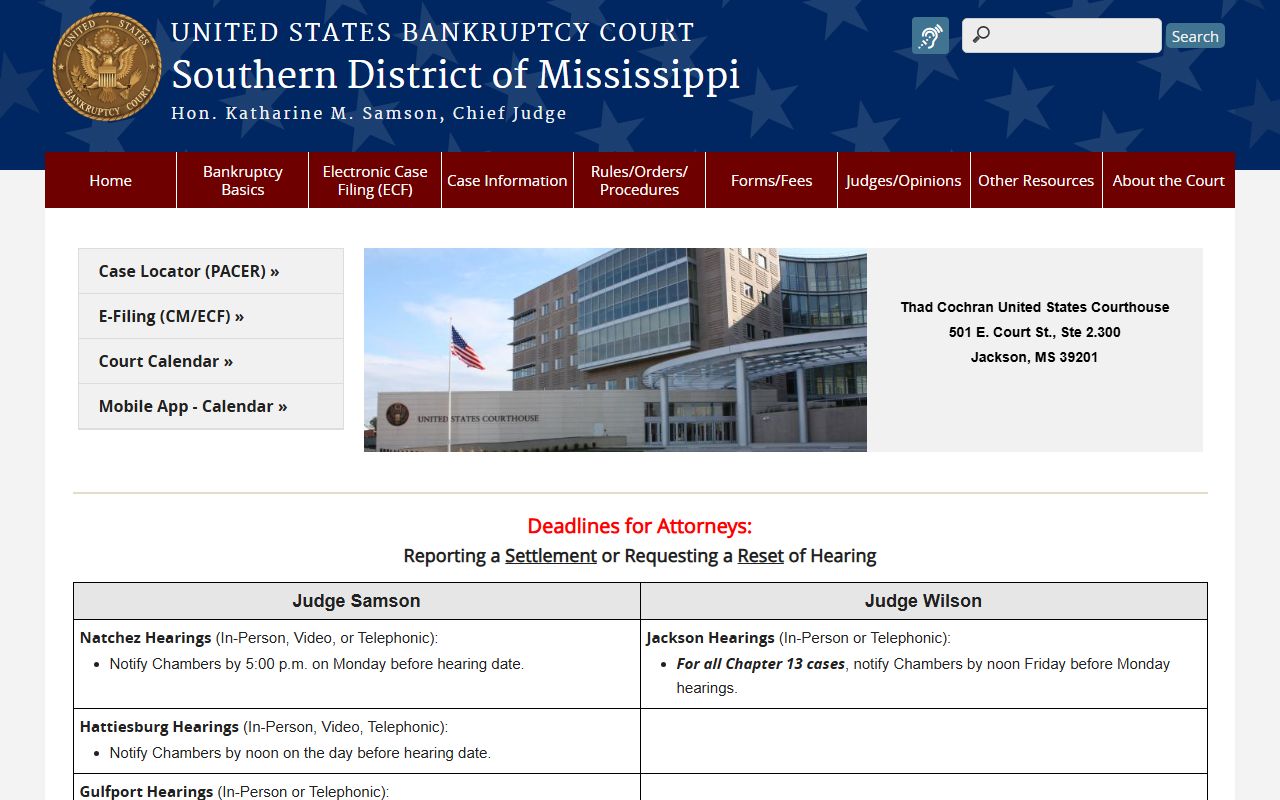
Bankruptcy is its own federal court entirely. Anyone tracing debts tied to an estate may end up at the U.S. Bankruptcy Court for the Southern District of Mississippi, which keeps bankruptcy filings well apart from a chancery estate file. A debt discharged in bankruptcy is a federal matter, not a probate claim filed with the Chancery Clerk.
Appeals from these federal cases climb to a different court still. The U.S. Court of Appeals for the Fifth Circuit reviews decisions from the Southern District of Mississippi. None of these federal courts decide a Kemper County will, estate, or guardianship, which all remain with the local Chancery Court and its clerk.
The takeaway is simple. For a will, an estate, a guardianship, or a conservatorship in Kemper County, start and usually finish with the Kemper County Chancery Clerk, and treat the federal courts as a separate system reserved for federal questions and bankruptcy.